Tag: books

  • Mourning The Illusion

    Mourning The Illusion

    When viewing images of the American secret police murdering a woman in broad daylight, I am reminded of a quote from the Battle of Helms Deep that expresses my frustration and helplessness. While under attack, Theodan, king of Rohan mutters “what can man do against such reckless hate.” I have thought about this line often as every day as I am bombarded with more horrors wrought by my own government. 

    My invocation of “Lord of the Rings” may come as a surprise because conservative thought leaders have interpreted Tolkien’s “Lord of The Rings” as a direct allegory to support their ideology. Writers like Curtis Yarvin consistently emphasize the ugliest and most racist pieces of Tolkien, and claim his tale of kindness, brotherhood, and basic decency as their own. As if Tolkien would feel affinity for the collection of tyrants, meddlers, and thieves that control our current government. No, Tolkien’s story was not meant to be straightjacketed into some white supremacists vision of “the west,” but instead is a story about sorrow, memory, and beauty told on the timescale of one life and generations. A story my mind returns to again and again in these evil times. 

    I have long believed that the secret to why Tolkien’s adult fairy tale continues to enchant young and old alike is that he has a remarkable knack for names. This comes as no surprise given his background as a linguist (he did write Quenya before the first lines of Bilbo’s tale), but it is no less remarkable how a simple name can evoke such feelings of peace, dread, or sorrow. Eldar names like Caras Galadohn, or Gil-Galad, Edain names like Minas Tirith, or Numenor, and sites of ancient evils like Angmar, or Barad-Dur conjure entire histories even though a place called Rohan never existed. The history and meaning behind these names add poignancy to key moments within the story, such as when Frodo makes the decision to take the ring to Mordor and Elrond states that his name will be remembered among the great heroes of the first age like Turin Turambar and Earendil. Even if the reader has no knowledge of who these made up people are, it still stirs something within, a feeling that the quest to destroy the ring is not isolated, but fits into a history, a legacy of heroes. 

    What I find most laced through Tolkien’s names, especially those of ancient Eldar or Edain places and people, is an undercurrent of sorrow. A wistful memory of some older time where great deeds were still possible and the power of kindness, friendship, and love were able to overcome evil. When considering Tolkien’s context and personal life, these desires to return to earlier times should not be interpreted as some anti-progressive screed, but instead reflect Tolkien’s desire to return to his life before his experience in world war one. The hope to return to the ancient battles of Beowulf or other myths should be understood as contrasts to the modern charnel house that greeted him in the trenches of France, not as a power fantasy of some sword wielding alpha male. 
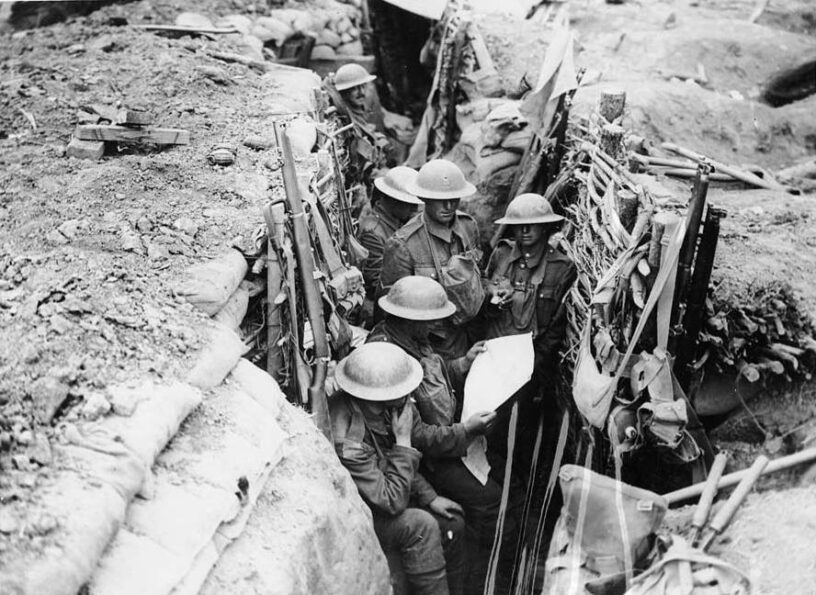
    See, Tolkien never, not even with the Return of Aragorn to the throne in Minas Tirith, allows that ancient glory alluded to in those names to be recaptured. The greatest example of this is the Eldar. The elves who stayed to fight the War of the Ring do not remain to make Middle Earth Great again, restoring the old kingdoms of the Sons of Feanor. No, they depart, over the sea, to the far green country never to be seen again. With them, they take magic, and beauty, and peace, making Middle Earth much less wondrous. The connection between the leaving of the Eldar and the end of the wonder of youth that we all feel as we grow old, gather scars, and meet the world as it is, not just how it could be, is the power of Tolkien, not the ideological project that Thiel and Yarvin embrace. If you don’t believe me, just ask Tolkien himself who famously said that he “disliked allegory in all its manifestations.” 

    Towards the end of The Return of the King, after the Shire has been saved and the evil of Sauron defeated. Galadriel, one of the oldest of the Eldar ever to walk Middle-Earth begins her voyage to the undying lands. She stops in the Shire, and engages in all manner of Hobbit-like revelry, dancing and drinking with the rest of the Shire-folk. Galadriel also brings with her a few seeds of the Mallorn tree from Lothlorien to plant in the Shire before she leaves forever, never to return. Her gift is not wasted, and Samwise plants the seeds which grow into the last Mallorn Tree that ever stands in Middle-Earth. Even when Lothlorian fades, and magic leaves Middle-Earth, the Mallorn tree still stands as just a piece of what was lost. 

    I always found this episode at the end of the story moving. The Mallorn Tree seemed to reach outside the pages of “The Lord of the Rings” and be a small piece of the story I could take with me out of Middle-Earth and into the “real world.” I wonder if Tolkien was able to preserve his Mallorn Tree through the trenches of the Great War, so that even when he was surrounded by suffering and death he could still remember a better time, or a better place.
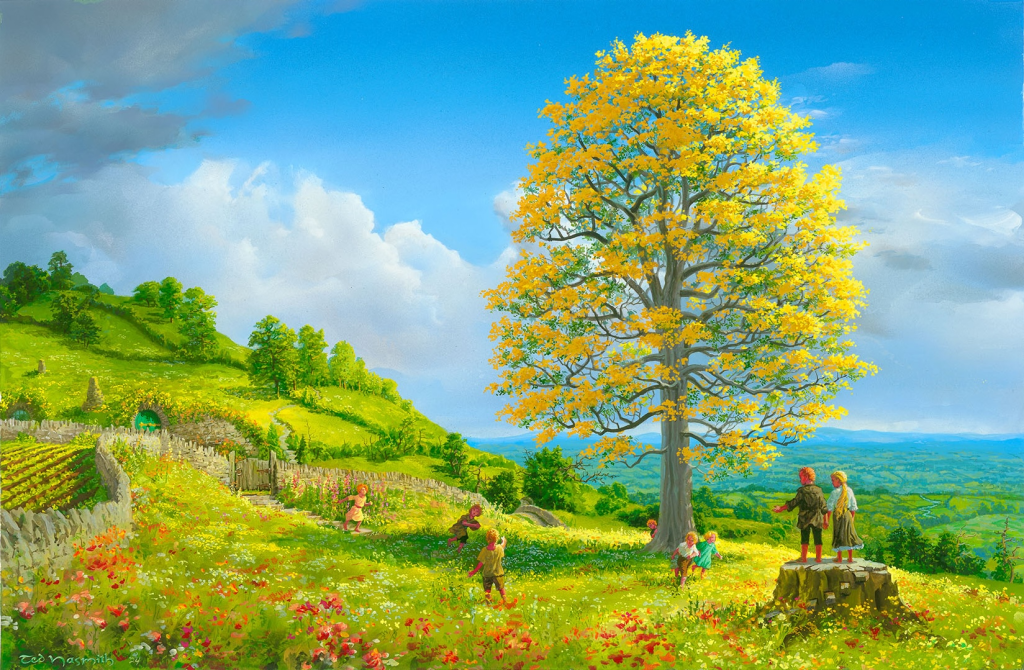
    “A Mallorn in the Shire” by Ted Nesmith

    And it’s not like Lothlorien was perfect, or that the days during the War of the Ring were peaceful, or that the Eldar that lived within the trees were pure. One of the other inconvenient facts of Tolkien’s wistful and melancholic view towards the past fascists hate to grapple with, is that every one of those ancient and great nations of Middle-Earth were riddled with corruption, evil, and hatred. Whether the kin slaying done by the Sons of Feanor, the tyranny of Az-Pharazon as he listened to Sauron’s council and made war against the Valar, or the greed of the Dwarves as they dug in Moria, no great nation that inspires songs and tales was an uncomplicated force for good much less perfect. But when they are remembered in bleaker times, the realities of their greed and ambition fall away, and when the name Numenor is whispered on the streets of Minas Tirith the parts that were are what is remembered. 
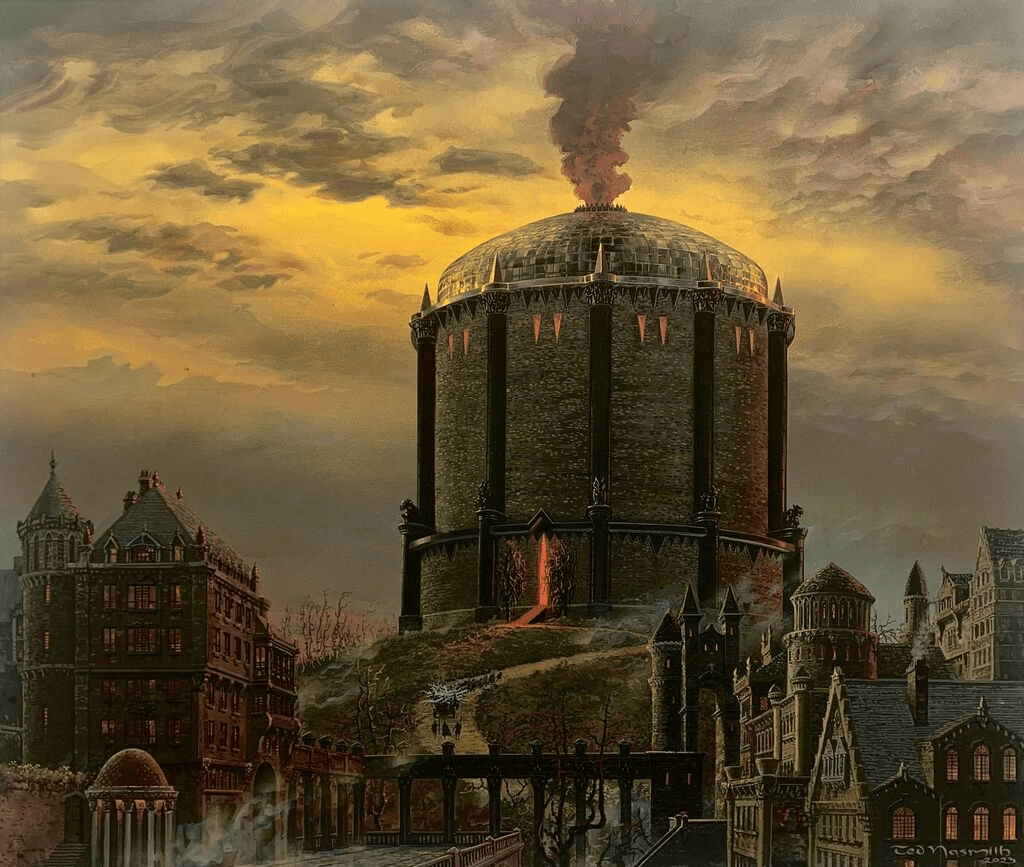
    “The Temple of Melkor” by Todd Nesmith

    When young hobbits look at the Mallorn tree, they do not think of the War of the Ring or the hatred between the Elves and the Dwarves, instead they think of the beauty that was once in the world that has passed away. The Mallorn tree stands to show that Lothlorian was once a place, and at least some parts of it were beautiful. 

    As I watch masked men of the American secret police roam the streets, I cannot help but think of the Mallorn tree and feel wistful for better times. I know my melancholy is not universal, those who were ground under the heel of Numenor surely do not see beauty in its edifices, but I also do not feel like I am alone. Perhaps I am a fool for ever believing that in the words of Martin Luther King Jr. we could “transform the jangling discords of our nation into a beautiful symphony of brotherhood.” Or the words of Abraham Lincoln when he said “that government of the people, by the people and for the people shall not perish from this earth.” I mourn that living up to those words seems less and less likely every passing day, even if they always were an illusion. 

    I think of the Mallorn tree in the Shire, and hope to plant my own. Not to hold up the past as an uncomplicated better time or to ignore the evil, hatred, and corruption that have plagued America from the beginning, but instead in these evil times to just remember that America was once a place, and at least some parts of it were beautiful.


    “Minneapolis Skyline Art” by Justyna Jaszke
  • End of Year Reflections

    End of Year Reflections

    Hi all!

    It has been a hell of a year. Professionally, politically, and personally 2025 had higher highs and lower lows than any year I can remember. The publication, launch, and promotion of Profane Beasts is easily one of the greatest peaks not just of this year, but of all my journeys around the sun. Profane Beasts had a successful launch at the wonderful Abi’s Books and Brews, was discussed on the excellent ‘Drinks in the Library’ podcast, was featured on a curated Ingram Spark list for horror around Halloween, and was one of Ingram Spark’s Horror Selections for their Editorial list sitting alongside other horror standouts like Nat Cassidy and Phillip Fracassi!(OMG)

    Other highlights included participating in Shelf Life RVA’s BrewHoHo with ten other incredible writers, discussing Profane Beasts with a book club, and seeing my book on the shelves at independent bookstore stalwarts in Richmond like Fountain Bookstore and Shelf Life Books RVA. Taken together, I can’t call the publication of Profane Beasts anything but an overwhelming success. It feels so good to make the move from someone who is ‘working on a book’ to someone who is ‘available now in local bookstores!’

    None of this, and I mean none of this, would be possible without the thriving local bookstore scene in Richmond. As billionaires and tech barons continue to try and become the only game in town when it comes to all expression of human creativity, Richmond’s independent bookstores remain a source of light. With the internet drowning in all forms of AI sludge, and monopolies tightening their grip on the distribution process, now more than ever I think it is important to meet together at these spots to laugh, argue, and embrace books.

    As for the future, I sincerely hope that Profane Beasts is not the end of my authorial journey, but instead a beginning. Right now, two projects have my attention. I can’t say much more, but for now let’s call them SciFi Project #1 and SciFi Project #2. Don’t worry horror fans, both projects are heavily influenced by some of my favorite outer space haunted houses (The Nostromo, the Ishimura, the 343 Guilty Spark Level in Halo and so much more!) I’m beyond excited for both of these projects, and have hope that at least one of them will be ready sometime in 2026!

    That’s not to say Profane Beasts is in the rearview. Copies are availible locally at Abi’s Books and Brews and available in store and to order at Fountain Bookstore and Shelf Life Books RVA. An e-book version is also in the works so stay tuned for further announcements!

    Alright, I have to stop here before I overpromise. Thank you to everyone who has supported me over the past year. You have given me a gift I can never repay, and here’s looking forward to 2026 and all the years to come.

  • Profane Beasts Preorder and Release Date

    Thank you to Everyone who came out to the virtual cover review for Profane Beasts! I am so happy to be able to share the cover with you below!

    Profane Beasts releases on September 25th, 2025. The pre-order is now live at the link below!

    https://shop.ingramspark.com/b/084?params=tJ8DX5HETKhsRwTt2xvbc4FTWgFKFzVT49NnHbr2q2r

    If you are still uncertain of whether or not Profane Beasts is for you, check out the second excerpt from the book below, chronicling the final message between the troubled Kelly and her therapist Alice.

    (The following voicemail was left on Alice Crenshaw’s phone by Kelly Harden on August 7th at 3:30 PM. The voicemail left on Alice Crenshaw’s phone at the time of recovery for this investigative report indicating that it was not deleted. The voicemail mentions a photo that was also sent to Alice Crenshaw at 3:35 PM via text. The photograph was saved in Alice Crenshaw’s photos.)

    (Voicemail begins)

    Alice, I’m not surprised you aren’t picking up. Probably fair given all the times I let you go to voicemail. I know now that you were trying to help. I said some cruel things in the email I sent you. The more I thought about it, the worse I felt, especially after all you did for me. If I’m being honest Alice, you’re the first person who seemed to genuinely want to help me. Typical of me to drive you away, it’s a pattern, probably something I should talk to a therapist about.

    But I didn’t call you to talk about those emails, or that night. I called because I think, for the first time in years, I’m getting some answers. Answers about what happened at camp, answers about what happened at Calvary Baptist, answers about this whole fucking city. I can’t tell you over the phone, they could be listening, but I’ve gotten to the root and I feel better than I have in a long time.

    Answers are what I hoped to get talking to you. Tactics and strategies to help me be less anxious, less worried just living my life, more functional whatever that means. I know you did your best, but that wasn’t enough for me, wasn’t what I really needed. What I needed was to understand why, how sending me to camp, all of that poison they put in my mind was connected. Putting together the bigger picture you know? Because only once you understand why something awful happened to you can you do something about it. Now I know things. Things the people here wouldn’t want to get out, wouldn’t want to go public.

    And that’s the thing about it isn’t it? Now that the hateful, dangerous center is exposed I can stop it from hurting anyone ever again. That would make my suffering meaningful.

    Do you remember the testimonies that people used to give during church? Some Sunday morning where a random member of the church would talk about the “dark times” that they suffered through? I remember one time that Ms. Shelly, I guess just Shelly now that we are whole ass adults, stood up there and talked about how Jesus was the reason she had been able to leave her boyfriend. She talked about him selling pot and all the other “sins” she fell into with him. But at the end of the talk, after detailing the long list of wrongs she thought she did, she said it was all worth it because it showed her how much she needed Jesus.

    Maybe it’s the same for me. Maybe I was paranoid and anxious for a reason. Now I’ve gathered the facts and best believe me, when I’m finally ready to tell everyone what has been happening here, I’ll absolutely be in the news.

    I’m going to send you a photo of what happened to my door. Don’t worry, I think it’s good that they are trying to scare me, it means I’m getting closer to the truth. Call me back when you can so we can talk about when you are coming down to help. Make what happened to both of us mean something.

    Talk to you soon!

    (The message sent to Alice Crenshaw held a single photo taken in midday light outside of Kelly Harden’s residence. The residence was a two story town house made out of brick nestled between two other units. In the center of the photograph is a closed blue door beside a bay window. The door bears extensive burns and gouges some over two inches wide and an inch deep.

    The gouges have neat edges and are too symmetrical to be considered accidental damage. Two large gouges between two and three feet long sit around four feet apart in the center of the door. These cuts seem to bloom upwards suggesting the figure of some large tree. Shallower lines of damage appear towards the top of the door giving the appearance of limbs or branches.

    Burn damage is evident in the center of the door between the two deep slashes in the door. Seven circles are placed in seemingly random order between the long cuts. These circles are blackened as if they were placed with a brand or other superheated object. At the center of each of these circles is a small point. The circles are not similarly sized with larger circles appearing at the top of the door and smaller circles appearing at the bottom of the door.

    Near the top of the door are a pair of painted white clouds that are unmarked by the damage. Another set of clouds  have been destroyed by the brands and cuts. Before the vandalism, the door seemed to be a pastel depiction of a sunny day one could find in a child’s coloring book.)