In the 96th minute of the World Cup round of 16 between Mexico and England, Mexican forward Santiago Gimenez stepped wrong when pursuing a through ball and suffered a severe ankle injury. At the time, Mexico was out of their assigned substitutions, but Santiago couldn’t walk let alone play on his ankle which had been surgically rebuilt last year. In a final act to try and help his team, Santiago pulled himself off the pitch and laid in agony while he was worked on by team medics. After the game, he was rushed to a hospital where it was confirmed that he suffered a serious ankle sprain, but not a full fracture as was initially feared.
While some sports legends have turned in mythic performances through injury, the reality is that the human body has limits that cannot simply be overcome with mind over matter. Pain can be put off, minimized, or pushed through only to a point before things start breaking inside the body. Ignoring or “pushing through” the pain can have devastating consequences even for professional athletes. Look no further than Isaiah Thomas of the Boston Celtics who pushed through a severe hip injury to play in the Eastern Conference finals. His career was never the same as it was revealed the injury led to his bones grinding together as his hip joint was simply gone. Thomas returned to basketball after multiple surgeries, but was never the same dynamic player again. Pain is how the body communicates it’s limits, and we ignore it at our peril.
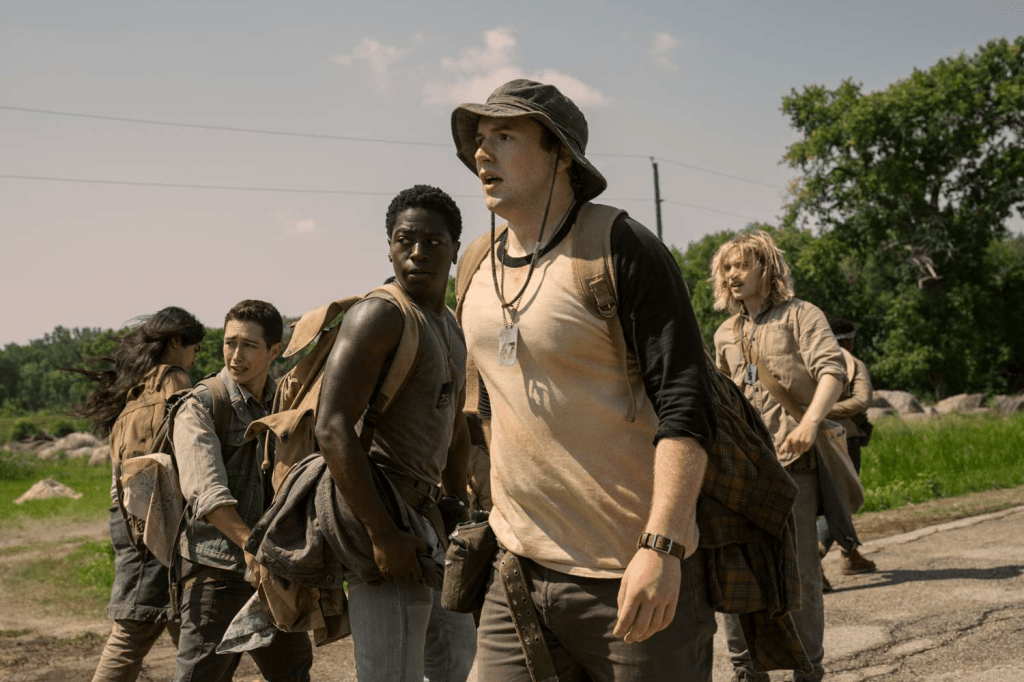
These limits are explored in excruciating detail in the movie The Long Walk based off of a Stephen King’s story of the same name. The concept is simple, fifty boys between the ages of 16 and 18 walk until only one is left. If a boy slows below the required pace, they are unceremoniously executed with a bullet to the head after a set of warnings. The rules are absolute. You slow down, you die, you run, you die, you try to fight back, you die, you beg for mercy, you die and supposedly only the strongest survive.
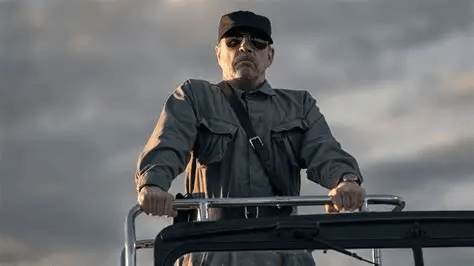
While the boys walk, they are exhorted by “The Major” an unrecognizable Mark Hamill who seems to relish his role as the assistant coach from hell. Hamill is able to embody the ethos of that one assistant coach who cares less for improvement in the sport and more for having a captive audience to sermonize to. A coach who always got way too excited for wind sprints at the end of practice, and loved calling players they dislike ‘soft.’ Hamill adds menace to his performance by his frequent exaltations and sermonizing from his jeep about how participating in the walk is a sacred and important duty. He provides the carrot through his discussion of eternal glory and reward for the winner, while the jeeps of machine gun armed men provide the ever present stick.
But the Major, the armed men, the reasons the boys walk, all are much less important than the actual structure of the walk itself. Notably the warning structure, that if a boy slows below the required pace of three miles an hour they are given three warnings, before on the fourth one they are shot. This matters because it turns the act of stopping from a bodily necessity to an act of defiance. Stopping is a choice a boy makes, and they are warned of the consequences. With the logic of the walk, a boy dying is their own fault not the fault of the men who pull the trigger.
The walk functions as a kind of behavioral experiment putting a person’s needs in conflict with their ability to obey the rules. The social order of the walk is absolute, there are no poison berries the boys can take to stick it to the Major or disrupt the system. The system does not care for the boys needs, it cares for their obedience, and this fixation with compliance has many proponents among the powerful.
One of particular note is Dr. James Dobson who because of his personal disgust with the protest movements of the 60’s, wrote a book called Dare to Discipline. Within its pages, he supposedly diagnosed the root of social changes that rocked America. Instead of accepting that large numbers of young people were ideologically opposed to the Vietnam War, segregation, and the homogenous social order of the 50’s, Dobson claimed that a breakdown in parental authority was to blame for the supposed anarchy spreading across the country. Lack of respect in the home had snowballed into lack of respect for the police, the state, and the social order. In order to restore respect for authority, Dobson proposed his own method of parenting that rejected the permissive ways of the world and devoted itself to instilling respect for authority in young children.
Dobson’s methods for asserting this authority are a chillingly precise merging of scripture and behavioral conditioning. A pediatric doctor, Dobson was familiar with behavioral theories in modifying children’s actions through things like reward systems and consistent application of positive and negative consequences. However, unlike most behavioralists, Dobson rejects the idea that children are trying to communicate their needs to caregivers, and instead believes children to be inherently sinful and rebellious creatures. In Dobson’s view, when a toddler spits at their caregiver because they are testing new forms of communication, it is not a developmentally appropriate milestone in learning acceptable and unacceptable forms of communication. It is instead an act of deliberate and sinful defiance that comes from the toddler’s rebellious nature and must be corrected with violence, immediately. Like God’s correction of Israelites, when defiance occurs, a price must be paid.
Ever the behavioralist, Dobson is precise in when and how punishment for defiance should take place. He believes that children under 10 and as young as 2 should be spanked with either a hand, belt, or other object with “sufficient magnitude to cause the child to cry genuinely.” What “cry genuinely” means is left up to the parents interpretation, making it a question of personal preference whether a child bares their behind for strikes or is beaten with a wooden spoon or a two by four. Parents are tasked to set clear rules, like the clear rules of the walk, but if they are defied just listen to how Dobson describes how parents should react.
“When a youngster tries this kind of stiff necked rebellion, you had better take it out of them and pain is a marvelous purifier. When a nose to nose confrontation occurs between you and your child, it is not the time to have a discussion about the virtues of obedience…You have drawn a line in the dirt, and the child has deliberately flopped his big hairy toe across it. Who is going to win? Who has the most courage? Who is in charge here?”
The anticipation and excitement that comes through the passage here from Dobson is harrowing. While later in the book he of course yada yada’s his way through generic condemnations of the physical abuse of children, that’s impossible to believe when this passage makes more sense as a pep talk for a heavyweight boxer than a book on good parenting. Dobson is giving permission for parents to “do what they gotta do” to re-establish their absolute authority. When discussing whether or not a child is allowed to be safe Dobson states that “he can enjoy complete security and safety, until he chooses to attack me. Then I will give him a reason to fear.”
All a child has to do is just obey, much like all the boys need to do is keep walking. To stop obeying is to risk safety, and there is nothing either the walkers or children raised with Dobson’s method can do to escape.

In response to Dobson, parenting experts often claim that “corporal punishment doesn’t work” I think this misunderstands Dobson’s goals. You see, parenting experts’ believe their work can help caregivers raise an emotionally intelligent, inquisitive, and independent children. That is not Dobson’s goal. Dobson’s goal is to raise children who never talk back, never question authority, and uphold “family values.” The goal is not for a child to develop into their genuine self because all children are tainted by original sin. Instead, the goal is for the child to be conditioned above all other concerns, to obey the rules.
Here the echoes of The Long Walk become clear. Why are the boys walking? Because they were told too. While they may have had a choice to sign up, once the walk begins the rules are absolute. They must obey even if it destroys their minds and their bodies, or they will be deemed weak and defiant. Whatever happens after that, well you can’t say they weren’t warned.
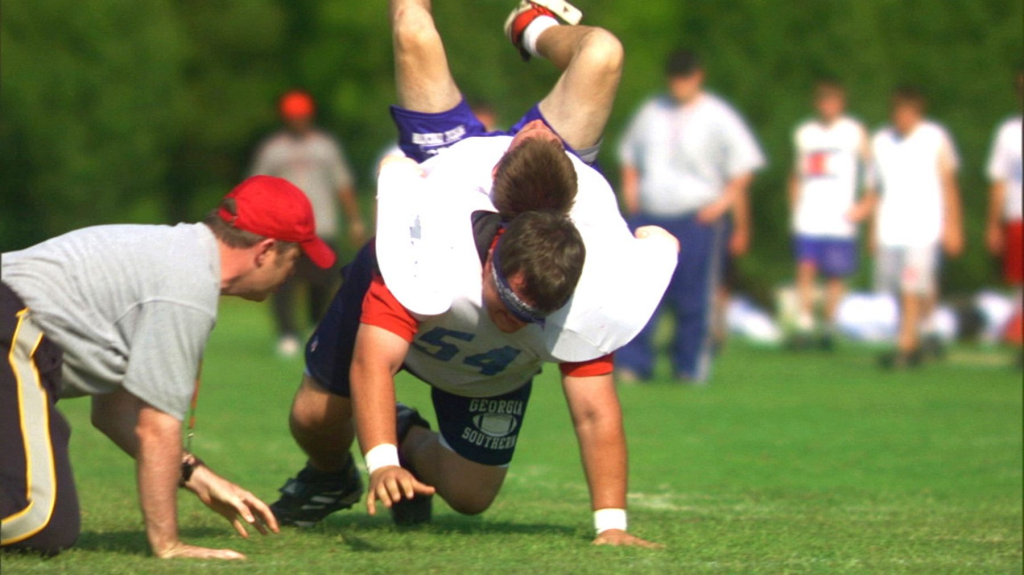
But there has to be a positive vision of this philosophy, of blind obedience resulting in something good for the parent and the child? How’s this theory supposed to work in practice, as even with my disgust for Dobson I doubt The Long Walk is what he thought of when he wrote his parenting books. To return to sports, the ‘good’ ending to these methods can be found in the Sherwood Pictures film Facing the Giants, a movie mostly about high school football. After a star linebacker expresses doubt over the team’s ability to win an upcoming game, his coach has him engage in a bear crawl with another student on his back. The catch is that the player has to do the task blindfolded so he doesn’t know how far he is going. Instead he has to just listen to his coach, and “give it his all.” The music swells, the coach screams at him to put his heart into it, and wow look at that, the player went twice as far as he thought he could.
Dobson’s philosophy is on display here. The player is singled out due to having a bad attitude and talking back to his coach. In order to teach a lesson, the coach puts the player in a situation where they are totally dependent on him, lies to them about the requirements of the task, and then disregards the player’s cries for help that his arms burn, that he is in pain, or that he can’t keep going. The only thing that stops the pain is when the player literally collapses onto the ground and weeps openly that “he doesn’t have anymore.” Here Dobson’s prescription that punishment should continue until the child “cries authentically” is reproduced, and because of the exercise, the player develops into the man of God the coach needs to win the football championship. As Dobson says “pain is a great purifier.”
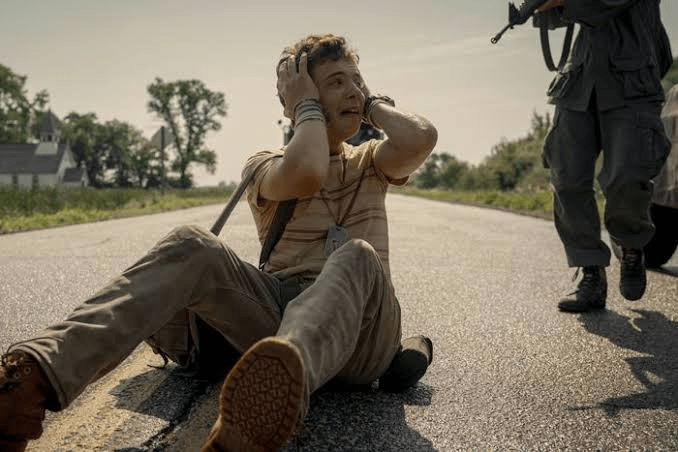
Right before the opening titles roll on The Long Walk there is a dark mirror of this scene from Facing the Giants. The youngest walker, a definitely not 16 year old named Curly, develops a charlie horse a few moments into the walk. One of our main characters, Raymond, immediately steps in and tries to coach Curly through it. The scene would not be out of place in a Facing the Giants style sports movie where Garrety does his absolute best in order to help Curly. It seems to work, Curly’s pain easing, until the cramp returns bringing Curly down to the ground.
Every boy screams at him to get up, but Curly can’t, his body has failed him. A fate that can happen to anyone, even professional athletes at the world cup. The final warning comes, there’s a graphic close up of Curly’s head being destroyed by the bullet, and the opening titles roll, letting the audience and the rest of the boys know what they are in for. The killing of this younger character makes it clear that there is no reasoning, no begging with the Major that will spare a boy’s life. Trying to negotiate is not an option, and the boys adapt, not begging with the implacable men with guns that follow them but instead with the boys whose bodies fail. In the closed world of the walk, the only way to stay alive is obedience above everything else, and an utter annihilation of the child’s own needs.
The most disturbing death of the walk comes after a frantic dash up a steep hill that the Major believes separates “the wheat from the chaff.” One of the boys breaks his ankle and the soldiers start to circle him with their automatic weapons. Mad with terror the boy screams that he is fine and doubles his pace even while his foot is graphically caught underneath his shattered joint. The moment is brief, and for myself, I was hoping that the boy’s death would happen off screen, that we could intuit he didn’t make it up the hill. That’s not the kind of movie The Long Walk is though.

Instead we see in vivid detail what happens when you continue to walk on a broken ankle with the boy’s foot turned and desiccated. Only when his pace slows, when the soldiers begin to surround him does he finally tell them “my ankle is broken.” The soldiers give out the same warnings while the boy begs, but the rules remain absolute. He was warned, he continued to defy the rules, and because of that his safety and security are forfeit.
One of the more disturbing anecdotes in Dare to Discipline is an example Dobson uses to show the efficacy of his behavioral program, specifically how his manipulation of pain and pleasure will produce the kind of children he desires. Dobson tells the story of a fish that starved to death because it was behaviorally conditioned not to lunge for food. The fish would choose to avoid pain over its own physical needs. Even after behavioralists stopped hurting the fish when it lunged for food, the damage was done. Likewise, children raised in the manner Dobson suggests don’t take long to understand that any pain they are suffering is better than the pain that will come if they are perceived as defiant or disobedient. Regardless of the pain, regardless of a child’s needs, regardless of a child’s ability, they must keep obeying or suffer the consequences.
The boy with the broken ankle is like the fish in Dobson’s experiment. Caught between agony and terror, forced to shamble on until he just cannot obey any longer. This tension is similar to the tension described by survivors of domestic abuse at the hands of those who believed in Dobson’s method. One survivor in Talia Levin’s book Wild Faith describes their experience by recalling, ““I got spanked for not cleaning my room fast enough once, and when I went back to cleaning after my spanking, I had a depressed — or ‘rebellious’ — attitude, so my dad made me sing a cheerful hymn while I cleaned, and if I didn’t sound happy enough, I would be spanked again.” Perhaps the stakes are not as high as The Long Walk, but the survivor was put in a shockingly similar tension between pain and terror. A child who was just corporally punished by her caregiver was then forced to perform happiness in order to prevent the punishment from happening again. Dobson believes this tension is good as it forces children to internalize their pain out of a “Godly Fear” of what will happen to them if they disobey. A child’s own emotional reactions are evidence of original sin, just like if a walker slows below the required pace is evidence of laziness.
Dobson hopes that caregivers can create a closed system in the image of the long walk. A place where the rules are absolute, where children would rather self maim then disobey, and where there is no way out.


Leave a Reply